

The graphics card market is about to get really interesting. While current tech coverage remains hyper-focused on mid-range updates, a wave of massive hardware leaks from major original equipment manufacturers and supply chain insiders has completely blown open AMD’s long-term roadmap. The headline revelation? AMD is officially plotting its return to the ultra-high-end enthusiast segment with its next-generation architecture.
The upcoming silicon, codenamed RDNA 5 (and increasingly referred to in manufacturing circles as the “UDNA” unified architecture), represents a clean-sheet redesign of how a graphics processor operates. For gamers who felt left behind when AMD prioritized the mid-market with the Radeon RX 9000 series, these new leaks reveal an aggressive, uncompromising strategy. AMD is not just trying to close the gap; it is actively designing a platform engineered to challenge the absolute peak of the premium desktop GPU market.
The current constraints: Why high-end hardware slipped to 2027
To understand why the highly anticipated RDNA 5 architecture, and its rumored flagship iterations like the RX 10800 XT and RX 10900 XT, is targeting a 2027 release window, one must analyze the massive economic and physical constraints choking the current PC market. The entire semiconductor industry is currently navigating an unprecedented component crunch that has forced major architectural delays.
The primary bottleneck is an escalating global shortage of advanced memory modules, specifically next-gen GDDR7. As major memory fabricators divert their silicon wafer allocations to high-margin enterprise AI accelerators, consumer graphics cards are facing severe supply issues. This “RAMpocalypse” has already caused manufacturers to adjust retail pricing for existing lineups.
Furthermore, building an ultra-enthusiast chip requires highly advanced manufacturing nodes. AMD has tapped TSMC’s cutting-edge 3nm lithography for RDNA 5, which demands extensive validation testing to guarantee stable yields. Consequently, board partners at Computex confirmed that while the architecture is real, commercial deployment has naturally been aligned with 2027 to ensure component costs stabilize and supply lines can meet consumer demand.
AMD’s innovation: Dismantling the compute unit for clean-sheet silicon
The defining characteristic of the RDNA 5 architecture is a complete departure from the hardware layout AMD has utilized for years. Rather than simply squeezing more processing clusters onto a die, AMD is undertaking a fundamental structural overhaul to address long-standing performance bottlenecks.

In previous generations, standard Compute Units (CUs) had to share physical resources to process both traditional vector graphics and complex light-ray intersections simultaneously. RDNA 5 physically decouples these workloads into two entirely independent, fixed-function hardware pipelines:
- Radiance Cores: Specialized silicon blocks built exclusively to execute heavy real-time bounding volume hierarchy (BVH) ray traversal and intersections. This brings AMD to true hardware parity with dedicated tensor and ray-tracing hardware architectures.
- Neural Arrays: Dedicated matrix math engines developed in tandem with enterprise machine learning pipelines. These blocks are designed to natively process advanced, lightweight machine learning models directly on the die.
By separating these computing tasks into distinct physical zones, the GPU can render complex environments concurrently. This architectural leap is paired with a next-generation software feature set dubbed “FSR Diamond,” an upscaling framework engineered to operate natively alongside these internal Neural Arrays. This foundational overhaul serves as the baseline framework for the broader AMD Zen6 RDNA5 architecture roadmap, which maps out how gaming and compute pipelines are converging across the entire product ecosystem.
Specs showcase: The rumored flagship configurations
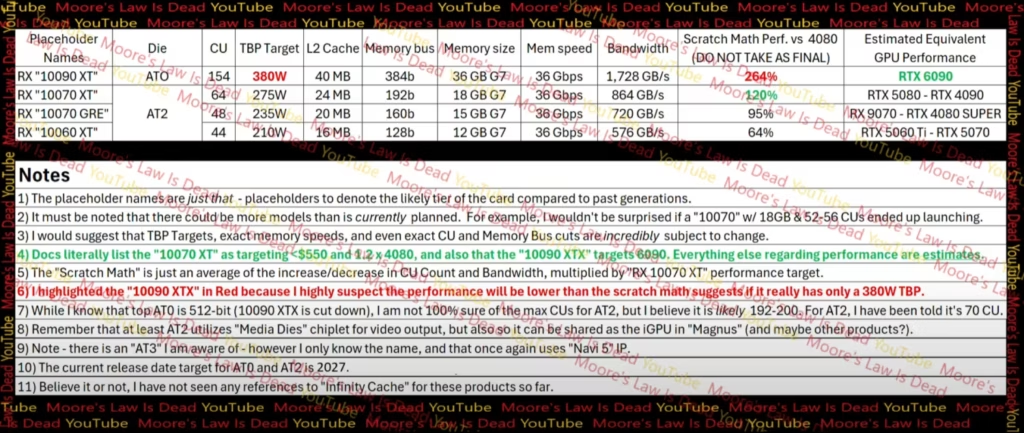
The raw numbers emerging from leaked original equipment manufacturer sheets indicate that AMD’s next-gen top tier will be a massive hardware showcase. By migrating to TSMC’s N3P node, the architecture achieves a massive 36% reduction in power consumption and a 24% reduction in die area compared to equivalent older configurations.
| Architectural Metric | Radeon RX 9070 XT (RDNA 4) | Rumored RX 10800 XT / 10900 XT (RDNA 5) |
| Process Node | TSMC N5 | TSMC N3P (3-Nanometer) |
| Silicon Codenam | Navi 44 / 48 | Navi 5X / “AT0” Flagship Die |
| Max Compute Units | 40 CUs | Up to 96 – 154 CUs Scale |
| Memory Standard | GDDR6 | Next-Gen GDDR7 |
| Memory Bus Width | 256-bit | 384-bit to 512-bit |
| VRAM Capacity | 12GB to 16GB | 24GB to 36GB Dynamic Range |
| Memory Bandwidth | ~600 GB/s | Up to 1.7 TB/s Maximum |
The physical scaling of the rumored top-tier variants represents an absolute monster of a chip. The maximum configuration leverages a massive 384-bit or 512-bit memory bus paired with ultra-fast GDDR7 memory modules, driving a staggering theoretical bandwidth of 1.7 terabytes per second. This massive focus on high-bandwidth efficiency mirrors what we are seeing on the desktop CPU side with the highly anticipated AMD Ryzen 9 10950X3D leaks and the Zen 6 Medusa architecture, which showcase AMD’s broader strategy of pairing ultra-high-speed memory configurations directly with cutting-edge manufacturing nodes.
Crucially for desktop builders, leaks point to a targeted thermal design power (TDP) of around 350W to 380W. Compared to the massive 500W+ power draws rumored for competitor halo products, AMD’s primary focus with RDNA 5 appears to be maximizing the performance-per-watt ratio rather than forcing consumers to purchase heavy 1200W power supplies.
How RDNA 5 helps us: Console alignment and the end of the “NVIDIA Monopoly”
The most significant real-world benefit of this hardware leak is not just raw frame rates, it is how this architecture secures long-term game optimization for PC users. AMD has designed the fundamental blocks of RDNA 5 in co-engineered partnerships with both Sony and Microsoft.
The custom semi-custom APUs powering next-generation hardware are heavily dependent on these advancements. This is clearly highlighted by leaks surrounding AMD Magnus in Microsoft Xbox consoles, which point to an elite, custom chiplet layout utilizing RDNA 5 cores and a massive NPU to drive native neural rendering directly at the living room level. This console alignment completely changes the software optimization paradigm for PC ports. Because multi-platform game developers will spend years tailoring their game engines to target the Radiance Cores and Neural Arrays inside the consoles, those optimizations will translate directly to desktop Radeon graphics cards.
Furthermore, by officially returning to the premium enthusiast segment with configurations targeting performance parity with top-tier competition, AMD forces a massive reality check on market pricing. This architectural efficiency isn’t limited to desktop GPUs or consoles either; it directly informs how AMD handles performance constraints in ultra-dense form factors, creating a massive competitive baseline as seen in our comparison of the AMD Ryzen AI Max 388 and 392 vs Intel Panther Lake. Increased competition at the absolute high end is the single most effective counterweight to halt escalating GPU retail costs, restoring long-overdue balance to the consumer market.
Frequently Asked Questions
According to the latest insider leaks from major OEM partners, desktop RDNA 5 graphics cards are currently targeted to begin initial shipments in mid-2027, with retail availability expected in the second half of 2027. This schedule aligns precisely with the development timeline for next-generation home gaming consoles.
UDNA is the rumored branding for AMD’s unified architecture strategy. While RDNA was built exclusively for consumer gaming and CDNA was built for enterprise AI data centers, UDNA seeks to merge the foundational pipelines back together, bringing robust machine-learning capabilities down to consumer gaming hardware.
Yes, current supply chain data reveals that AMD plans to completely phase out 8GB configurations for its next-generation architecture. Due to the memory tracking requirements of modern gaming assets, the baseline models for the RDNA 5 lineup will feature a minimum of 12GB of VRAM.
The massive leaks surrounding the RDNA 5 architecture prove that the high-end graphics card landscape is headed for a massive shakeup. By shifting away from iterative updates and completely rebuilding its silicon around dedicated, console-aligned ray-tracing and machine learning hardware, AMD is designing a compelling post-silicon blueprint to challenge the premium computing market.


