

For the better part of a century, the quest for room-temperature superconductivity has been the “Mount Everest” of physics. We have seen flashes of brilliance, but the true holy grail of zero-resistance power has always remained just out of reach, locked behind a wall of quantum chaos. This week, an international collaboration between the Max Planck Institute of Quantum Optics and the Simons Foundation’s Flatiron Institute has officially cracked that wall.
By peering into a mysterious state of matter called the “Pseudogap,” they have uncovered a hidden magnetic order that provides the first real blueprint for a world without electrical resistance. This is not just a scientific curiosity; it is the foundational physics that could lead to zero-loss power grids, desktop supercomputers, and medical devices that operate at ambient temperatures.
While the Max Planck team used quantum simulators to find this ‘Hidden Order,’ other teams are pushing the boundaries of how quantum information is shared. Recent breakthroughs in quantum teleportation from distant light sources are already proving that the quantum network of the future will be just as much about communication as it is about material science.
The mystery: The “waiting room” of matter
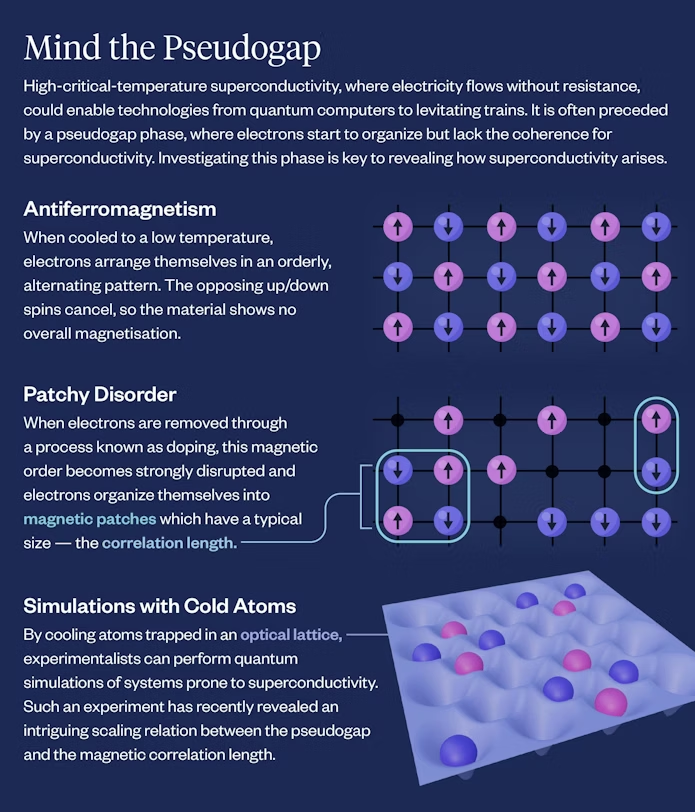
To understand this breakthrough, you first need to understand the Pseudogap. In high-temperature superconductors (materials that conduct electricity perfectly at temperatures achievable with liquid nitrogen), the material does not just switch from “normal” to “superconducting” instantly. Instead, as it cools, it enters a peculiar “waiting room” phase, the Pseudogap.
In this state, electrons appear to be stuck in a quantum traffic jam. They act like they want to pair up (the fundamental requirement for superconductivity), but they are held back by what looked like chaotic, disorganized interactions. For over 40 years, physicists could not agree: Was the Pseudogap a necessary precursor to superconductivity, or was it a competing state of matter actively preventing the full transition? Until now, the answer remained elusive.
The discovery: The “magnetic dance”
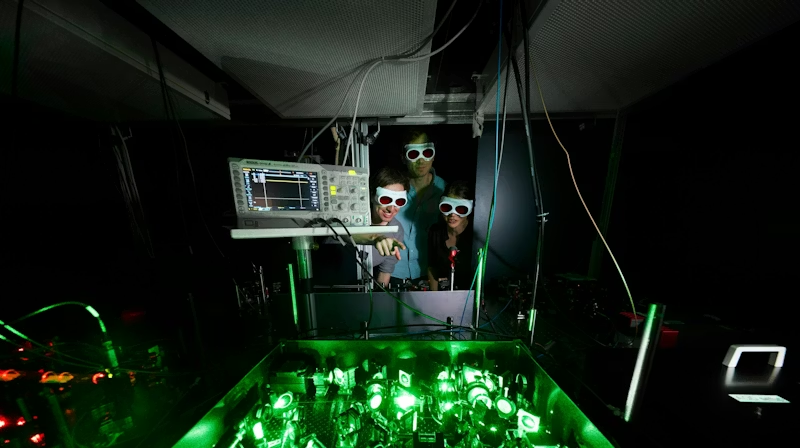
Led by researcher Thomas Chalopin and theorist Antoine Georges, the team used a cutting-edge quantum simulator. They supercooled lithium atoms to a mind-boggling billionths of a degree above absolute zero, making these atoms behave exactly like electrons in the Pseudogap phase. By capturing over 35,000 “microscope” images of these simulated electrons, they made a stunning realization: the perceived “chaos” was, in fact, a highly organized Hidden Antiferromagnetic Order.
- Universal Patterns: The team discovered that magnetic correlations within the Pseudogap follow a single, universal pattern that is directly tied to the temperature at which this phase emerges.
- Beyond Pairs: Contrary to previous assumptions, electrons in this state aren’t just interacting in simple pairs. They are engaging in complex, collective “dances” involving up to five particles simultaneously. This multi-particle interaction fundamentally reshapes our understanding of electron behavior in this critical phase.
- The Blueprint: This discovery unequivocally proves that the Pseudogap is a genuine, organized phase of matter driven by subtle magnetic interactions. By mapping this “hidden magnetism,” physicists now possess a critical blueprint, a set of instructions, on how to manipulate and control this phase.
How the technology will work: Hacking the Quantum code
The Max Planck discovery did not just find a new state; it handed us the “dial” to control it. For decades, searching for room-temperature superconductors was like trying to bake a cake without the recipe. Now, we know the exact “ingredients” and “steps” needed to encourage superconductivity.
Superconductivity requires electrons to form Cooper Pairs, bound pairs that move through a material without resistance. Normally, electrons repel each other. The challenge has always been to force them to “couple” and flow freely.
- The Problem: The Pseudogap was the phase where electrons wanted to pair but were trapped in a chaotic, competing magnetic order.
- The Solution: Manipulating the “Magnetic Dance”: The new understanding of the “Hidden Antiferromagnetic Order” reveals that the electrons are engaging in a specific 5-particle magnetic correlation. By applying precise “Doping” (strategically replacing certain atoms in a crystal lattice) or carefully engineering quantum materials, we can now “tune” these 5-particle dances. Instead of letting them settle into a chaotic magnetic pattern, we can use the “Hidden Order” blueprint to gently nudge them into stable Cooper Pairs at much higher, even ambient, temperatures. We are essentially “hacking” the quantum code of the material to bypass the chaotic Pseudogap and usher in perfect electron flow.
The material candidates: Building the future
While the Max Planck researchers used a quantum gas microscope with lithium atoms for their simulation, the goal is to translate these findings to tangible solid-state materials. The following are the leading candidates for developing the first practical room-temperature superconductors:
The “Cuprate” kings (Copper-Oxides)
These materials are the current record-holders for ambient-pressure superconductivity, operating at around -135°C (138 Kelvin).
- Target Materials: Yttrium Barium Copper Oxide (YBCO) and Mercury Barium Calcium Copper Oxide (HgBaCaCuO).
- The Mission: By precisely applying the “Hidden Order” findings, researchers aim to “re-dope” these existing crystals. The goal is to fine-tune their electron interactions to push that critical superconducting transition temperature closer to the boiling point of water (100°C or 373 Kelvin), making room-temperature operation a reality.
Nickel-based “Nickelates”
A relatively new class of materials that share structural and electronic similarities to cuprates but offer potentially cleaner experimental conditions.
- Target Materials: Neodymium Nickelate (NdNiO2) and other rare-earth nickelate compounds.
- Why They’re Promising: Nickelates often exhibit a very distinct and tunable Pseudogap phase, making them an ideal “clean slate” for testing the “5-particle correlation” theory. Their magnetic signals are often easier to isolate and control compared to the more complex cuprate systems.
“Twistronics” (Engineered Graphene Lattices)
This is a groundbreaking, atomic-scale engineering approach that uses pure carbon.
- The Mission: Instead of relying on complex chemical synthesis, researchers can create the specific quantum conditions necessary for superconductivity by stacking two or three layers of graphene at precise “Magic Angles”, often around 1.1 degrees. This literally builds the “Hidden Magnetic Order” from the ground up, allowing for unprecedented control over the material’s electronic properties.
The “Final Boss”: Ambient Pressure
One of the biggest historical hurdles for many “room-temperature” superconductor claims has been the requirement for extreme pressure, often millions of times atmospheric pressure, akin to the center of the Earth.
- The Game-Changer: The “Hidden Magnetic Order” was unequivocally observed and manipulated in a low-pressure quantum simulator. This is crucial. It strongly suggests that the elusive phenomenon of room-temperature superconductivity doesn’t require crushing force; it simply requires the correct atomic and magnetic arrangement to stabilize the Cooper Pairs.
- The Implementation: This finding dramatically accelerates the path to practical applications. We could see the first commercial Superconducting Power Cables integrated into urban grids by 2028, transmitting massive amounts of energy through pencil-thin wires with zero heat loss, even during a summer heatwave, without any need for exotic cooling systems.
How this changes your life: The timeline to a frictionless future
If the Donut Lab Solid-State battery is the engine of the future, this Superconductivity discovery is the fuel line for an entirely new civilization.
| Phase | 2026 (Now: Blueprint) | 2028 (Near-Term Implementation) | 2030+ (Widespread Adoption) |
| Power Grid | Lab Discovery of Magnetic Order | First Zero-Loss Power Cables (City/Industrial) | Continental Zero-Loss Grids |
| Computers | Quantum Simulation | Specialized Supercomputing Data Centers (No Cooling) | Desktop Supercomputers; Phones Last Weeks |
| Transportation | High-Speed Maglev Prototypes | First Commercial “Zero-Friction” Trains | Personal Levitation & High-Speed Transit |
| Medical | Fundamental Research | Compact, Powerful Research Magnets | Portable, Handheld MRI Scanners; Advanced Diagnostics |
| Devices | Material Testing | Specialized Zero-Heat Electronics | Wearables, VR/AR with Infinite Power |
If we can stabilize these magnetic ‘dances’ at room temperature, we could power chips that think like we do. This pairs perfectly with the development of Transneurons, single adaptive AI chips designed to mimic the human brain’s efficiency and learning capabilities
The pursuit of zero-resistance hardware is not happening in a vacuum. We are already seeing a shift toward specialized architectures, such as China’s new photonic quantum chips which is using light instead of electricity.
The tech enthusiast’s take
This is not just about faster computers or cheaper electricity; it is about fundamentally reshaping the physical limits of our technology. Imagine a world where your phone does not just charge in 5 minutes (thanks to advancements like hydrated sodium batteries), but it also does not waste a single drop of that energy as heat, staying cool to the touch and lasting for weeks on a charge. We are watching the birth of a truly frictionless civilization, powered by a deeper understanding of the quantum dance of electrons.
Scaling these materials will be the key to the next generation of European supercomputing. Projects like the Lucy quantum computer are currently the vanguard of this movement, representing the transition from lab theory to continental-scale infrastructure


