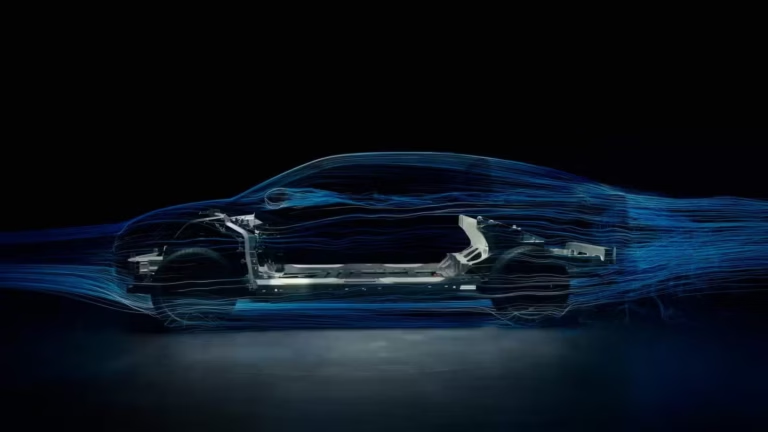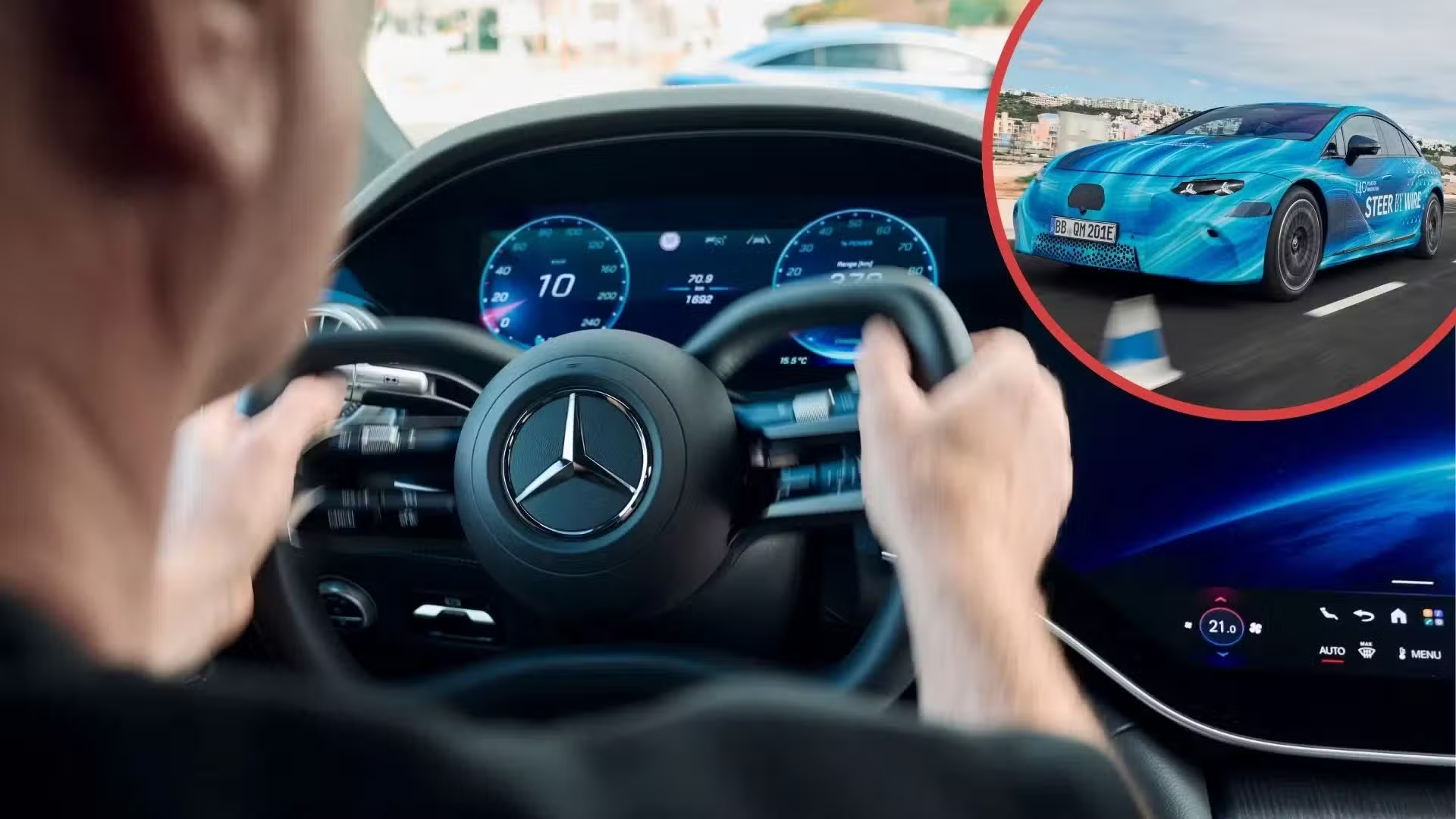
For 140 years, the connection between a driver’s hands and the road was a physical one—a solid metal shaft known as the steering column. Whether aided by hydraulics or electric motors, the mechanical link remained a safety-critical constant. However, as of 2026, the industry has reached a tipping point. With the launch of the refreshed Mercedes-Benz EQS, the mechanical column is being eliminated in favor of steer-by-wire, a system in which electrons, not iron, dictate the vehicle’s direction.
The evolution: From levers to electrons
The history of steering is a journey of reducing driver effort and increasing precision. In the late 19th century, cars used primitive steering levers that required immense physical strength. The introduction of the rack-and-pinion system in the early 20th century provided the first “direct” feel, which was later augmented by Hydraulic Power Steering (HPS) in the 1950s and Electric Power Steering (EPS) in the late 1980s.
While EPS used a motor to help you turn the column, the column itself was still there. Steer-by-wire represents the final decoupling. In this architecture, the steering wheel is essentially a high-fidelity video game controller. Sensors detect the angle and speed of your input and send that data via electrical cables to an actuator on the steering rack. This evolution is driven by the need for advanced driver-assistance systems (ADAS) and the transition to autonomous “agentic” driving, where the car must be able to steer itself without the steering wheel spinning violently in the cabin.
This transition from mechanical linkages to electronic actuators is a classic example of core race-car-to-road innovations, where technology designed for the extreme demands of the track eventually redefines the safety and agility of the daily driver.
Just as steer-by-wire is disrupting the traditional steering column, new propulsion technologies are challenging the status quo of the powertrain, most notably the revolutionary one-stroke internal combustion Innengine.
Technical deep dive: How the Steer-by-Wire system functions
A production-ready steer-by-wire system, like the one found in the 2026 Mercedes EQS, relies on a “handshake” between two primary units: the Steering Feedback Unit (SFU) and the Steering Rack Unit (SRU).
The Steering Feedback Unit (SFU)
Since there is no mechanical link, the “feel” of the road is gone. To prevent the steering from feeling like a lifeless toy, the SFU uses a powerful motor to simulate resistance and feedback. It calculates the restoring forces of the tires against the road and “pushes back” against the driver’s hands, filtering out unpleasant vibrations while preserving the characteristic Mercedes-Benz “heft”.
The Steering Rack Unit (SRU)
The SRU receives digital signals from the SFU and moves the wheels accordingly. Because this is controlled by software, the steering ratio is variable. At parking speeds, the ratio can be ultra-quick (turning the wheels fully with just a 170-degree flick of the wrist), while at highway speeds, it becomes less sensitive to ensure stability.
Redundancy and safety
The primary concern with removing the steering column is safety: What if the power goes out? To address this, manufacturers use redundant system architectures.
- Mercedes EQS: Utilizes two separate signal paths, redundant power supplies, and a fallback mode that uses individual wheel braking (via ESP) and rear-axle steering to maintain control if the primary system fails.
- Tesla Cybertruck: Uses a native 48V electrical architecture, allowing for high-torque motors with triple-redundant sensors to handle the immense load of a heavy truck without any mechanical backup.
| Feature | Traditional EPS | Steer-by-Wire (Pulsar era) |
| Physical Link | Mechanical Column | Electrical Cables (Wire) |
| Steering Ratio | Fixed (mostly) | Fully Variable / Dynamic |
| Road Feedback | Physical Vibration | Software-Simulated |
| Interior Space | Occupied by Column | Open / Flat Floor |

Benefits vs. disadvantages for the 2026 driver
The shift to digital steering offers massive rewards, but it also introduces new challenges that traditionalists may find jarring.
The benefits
- Variable maneuverability: As seen in the Tesla Cybertruck, you no longer need “hand-over-hand” shuffling. Maneuvering a 5,000lb luxury car in a tight garage becomes as easy as a 170-degree turn.
- Vibration filtering: Harsh jolts from potholes are no longer transmitted to your wrists; the software filters the “noise” while keeping the “signal”.
- Interior freedom: Removing the column allows for flatter dashboards and better visibility of driver displays. In the 2026 EQS, this even makes ingress and egress significantly easier.
The Disadvantages
- Complexity & cost: The need for triple redundancy and high-power actuators makes these systems significantly more expensive than traditional racks.
- Synthetic feel: Even with advanced feedback units, some purists argue that simulated road feel can never truly replicate the organic “dialogue” of a mechanical connection.
- Regulatory hurdles: Some regions are still catching up with the legislation required for vehicles with no physical steering backup.
Steer-by-wire trades mechanical simplicity for digital agility, offering a superior experience for the average commuter while challenging the “feel” preferred by enthusiasts.
The manufacturers leading the charge
While several brands have toyed with this tech, three companies have emerged as the 2026 leaders, each taking a unique approach to the digital rack.
Tesla: The triple-redundancy trailblazer
Tesla’s implementation in the Cybertruck is arguably the most aggressive, utilizing a 48V architecture to power dual motors on the steering rack. This allows for a “yoke” or small steering wheel that never requires more than 180 degrees of rotation. Rumors suggest a “Formula 1” tuned version of this system will be a centerpiece of the upcoming Roadster, focusing on hyper-fast response times that a mechanical rack simply couldn’t achieve without being too heavy for a human to turn.
Mercedes-Benz: The first German implementation
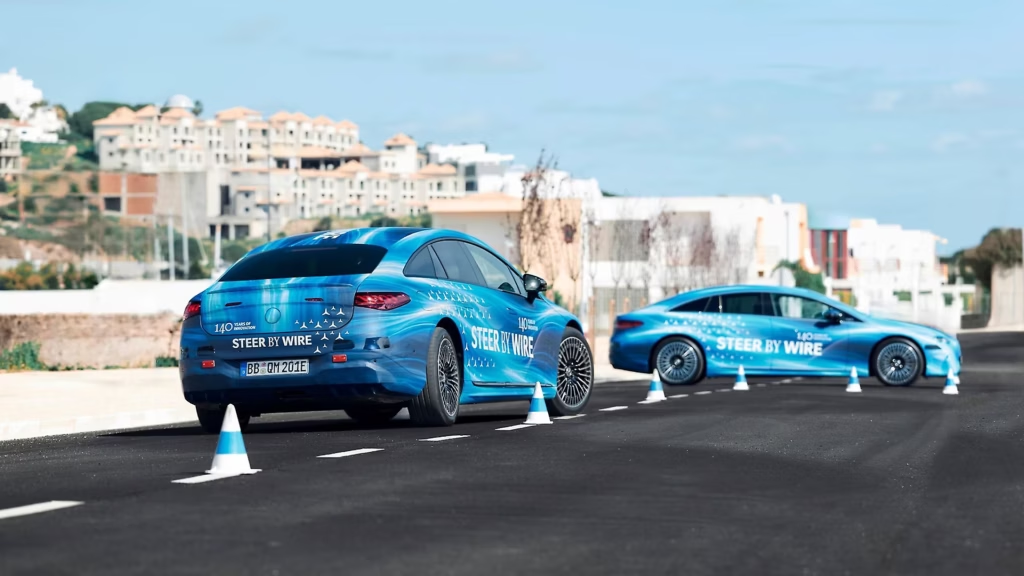
The 2026 Mercedes-Benz EQS facelift marks the first time a German production car has officially deleted the steering column. Developed in partnership with ZF, the system is paired with 10-degree rear-axle steering. This creates a “virtual wheelbase” effect: at low speeds, the car feels as small as an A-Class, while at high speeds, it remains as composed as a private jet.
Lexus: The “one motion grip” signature
Lexus has refined its One Motion Grip system for the 2026 RZ. Unlike others that focus purely on tech, Lexus is marketing the “Lexus Driving Signature”, a blend of comfort and extreme precision. Their system operates over approximately 200 degrees lock-to-lock, and the R&D team has invested significant time to ensure the haptic feedback through the steering grips feels natural rather than digital.
The road ahead: A digital horizon
The transition to steer-by-wire is more than just a mechanical upgrade; it is a fundamental shift in how we interact with our vehicles. By removing the 140-year-old steering column, manufacturers like Mercedes-Benz and Tesla are not just saving weight or space, they are paving the way for a truly software-defined driving experience. As we move closer to a future where “agentic” AI and autonomous systems take the wheel, the decoupling of the driver’s hands from the physical tires becomes a necessity. While the “synthetic” feel remains a point of contention for driving purists, the benefits of variable precision, safety redundancies, and cabin flexibility are proving too significant for the industry to ignore.
In the coming years, expect steer-by-wire to migrate from flagship luxury EVs to the broader automotive market, eventually becoming as ubiquitous as the electric power steering it now replaces. For the 2026 driver, the choice is no longer about how much physical effort is required to turn a corner, but about how much trust they are willing to place in the silent, lightning-fast handshake between sensors and software.
While premium EVs lead the charge, the trend toward digital precision is also influencing the return of legendary nameplates; for instance, the Honda Prelude 2026 return showcases how modern icons are balancing heritage with cutting-edge handling.
Frequently Asked Questions
Yes. 2026 systems use triple-redundant sensors and dual-power paths. If a total electrical failure occurs, many systems (like the Mercedes EQS) use rear-wheel steering and torque vectoring via the brakes to bring the car to a safe stop.
In some steer-by-wire implementations, the steering wheel can remain completely stationary while the wheels move, preventing the “ghost steering” effect and freeing up space for the driver.
Absolutely. Because the feedback is software-controlled, drivers can often toggle between “Comfort,” “Sport,” and “Individual” modes to change the simulated weight and resistance.