In 2026, the automotive industry is no longer just fighting over battery range; it is fighting over ownership. For decades, the “Gigafactory” model, championed by Tesla and adopted by Ford and VW, has prioritized economies of scale, leading to highly integrated vehicles that are often “totaled” by insurance companies after minor structural or battery damage.
However, a counter-movement is gaining momentum. The rise of the Micro-factory is proving that localized, small-batch production is not just a niche alternative, it is the technical foundation for a truly repairable vehicle. By 2026, the global micro-factory market is projected to reach $8.01 billion, growing at an explosive CAGR of 21.2% as manufacturers seek to bypass the rigid, anti-repair architectures of the past.
The gigafactory paradox: Efficiency at the cost of longevity
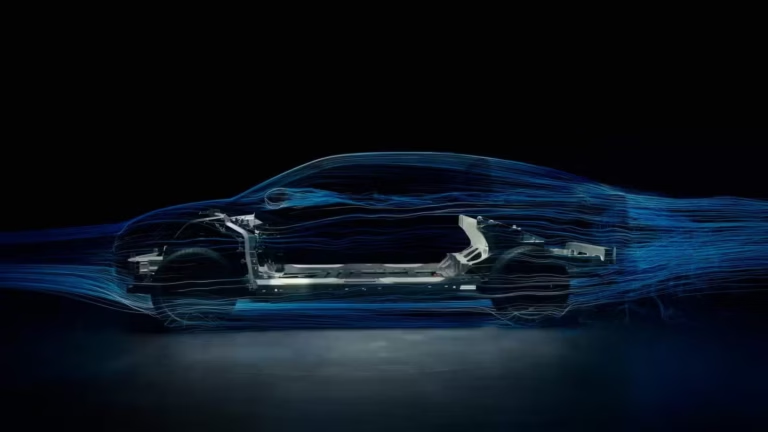
The Gigafactory is a marvel of 21st-century engineering, but it inherently favors disposable hardware. To achieve the throughput required to build 500,000+ vehicles a year, these facilities rely on “monolithic” construction, large, single-piece castings, and structural battery packs that are bonded or welded into the chassis. While this makes the car cheaper to assemble, it makes it nearly impossible to disassemble without specialized industrial equipment.
In 2026, the impact of this “monolithic” design is being felt in the insurance market. Minor accidents involving a Gigafactory-built EV often lead to a “total loss” because the labor costs to un-bond and replace a structural component exceed the car’s value. This “Gigafactory Paradox” creates a cycle of high-volume waste that contradicts the sustainable promises of the EV transition.
The exit takeaway is clear: while Gigafactories provide the scale needed for mass adoption, their inherent rigidity is the greatest obstacle to the “circular economy” that modern consumers and regulators now demand.
Not every large-scale manufacturer is sticking to rigid lines; the BMW iFactory flexible car building future demonstrates how digital twins and AI can introduce variety into a Gigafactory, though it still faces the repairability hurdles inherent in monolithic chassis designs.

Micro-factories: The modular engine of the ‘Right to Repair’
Micro-factories represent a fundamental shift toward decentralized manufacturing. Unlike Gigafactories, which require multi-billion-dollar investments, a micro-factory can be established for roughly $50 million in an existing warehouse. These facilities use autonomous mobile robots (AMRs) instead of fixed conveyor belts, allowing the production line to be reconfigured in hours rather than months.
This flexibility is what enables Modular Architecture. Because the assembly process is not fixed, the vehicle can be designed as a series of “plug-and-play” modules.
- Modular Batteries: In 2026, prototypes like the Aria EV (Anyone Repairs It Anywhere) have demonstrated that an EV can run on six independent 12kg battery modules.
- User-Level Swaps: These modules can be detached and replaced by hand, eliminating the need for high-voltage certifications or heavy lifting machinery.
- Click-On Panels: Micro-factory vehicles often use quick-release exterior panels that “click” onto the frame, allowing owners to replace damaged bodywork in minutes with basic tools.
By localized production near urban centers, micro-factories also drastically reduce the carbon footprint of logistics, proving that “small-scale” is the most efficient path toward long-term vehicle sustainability.
Just as the modular laptops tech industry future is being defined by swappable RAM and CPU components, the Aria EV applies this same logic to the road, treating the battery as a serviceable module rather than a sealed unit.

2026 legislative catalyst: The EU right to repair directive
The timing of the Micro-factory surge is not accidental. As of July 31, 2026, the EU Right to Repair Directive (Directive (EU) 2024/1799) has officially taken effect across member states. This law mandates that manufacturers must provide access to spare parts, tools, and repair information at “reasonable prices” for up to 10 years.
While the initial scope covers appliances and smartphones, 2026 has seen a fierce legislative push to include passenger vehicles.
- Anti-Blocking Measures: The directive prohibits manufacturers from using software or hardware locks to prevent independent repairs.
- Warranty Incentives: Consumers who choose repair over replacement now receive an extra 12 months of legal guarantee, a massive shift in consumer protection.
The Aria EV project has become the primary case study for policymakers in Brussels, demonstrating that if a car is designed within a micro-factory framework, it naturally complies with and exceeds these strict new repairability standards.
Comparative analysis: The cost of electric car ownership in 2026
To understand the true economic impact of these manufacturing shifts, we must look beyond the showroom sticker price. In 2026, the Total Cost of Ownership (TCO) is increasingly dictated by a vehicle’s “repairability index” and its battery chemistry, creating a widening gap between the high-scale Gigafactory models and modular Micro-factory alternatives.
Battery replacement: The $10,000 threshold
By early 2026, the cost of lithium-ion battery packs had dropped to a global average of approximately $105–$115 per kWh, with prices in China reaching as low as $84 per kWh. However, the type of battery and how it is integrated into the car remain the largest financial variable for owners.
- Gigafactory standard (NMC/Structural): For a mid-size SUV like the Tesla Model Y or Hyundai IONIQ 5, a full out-of-warranty battery replacement typically costs between $11,000 and $16,000, including labor. Because these packs are often structural elements of the chassis, “partial” repairs are technically difficult and rarely sanctioned by dealers.
- Micro-factory modular (LFP/Segmented): In contrast, modular platforms like the Aria EV utilize smaller, independent LFP (Lithium Iron Phosphate) modules. If a single segment fails, an owner can replace a 10kWh module for roughly $1,500–$2,500, avoiding the “total pack” replacement cost entirely.
While current modular designs rely on LFP chemistry for safety and cost, the next leap in lowering ownership costs will come from solid-state battery for electric vehicles, which promise higher energy density and even longer lifespans for modular frames.
The insurance premium gap
One of the most significant 2026 ownership trends is the “Insurance Gap.” On average, comprehensive insurance for an EV now costs 25% to 40% more than for a comparable petrol car.
- The “total loss” risk: Insurers are increasingly wary of Gigafactory-built vehicles due to their integrated designs. Even minor underbody damage to a structural battery casing can result in the vehicle being written off, as the battery represents 30%–40% of the vehicle’s total value.
- Repair complexity: EV collision repairs currently cost 20% to 30% more than internal combustion engine (ICE) repairs, averaging around $5,700 per claim. This is driven by a 20% longer “time-in-shop” due to a shortage of certified high-voltage technicians and the need for specialized safety inspections of the battery.

Comparison of ownership metrics (2026 Estimates)
| Metric | Gigafactory (Legacy EV) | Micro-factory (Modular EV) |
| Initial Purchase Price | Lower (due to mass scale) | Medium (lower overhead, less scale) |
| Average Repair Cost | High (Dealer-only, integrated parts) | Low (DIY or Independent, modular parts) |
| Battery Replacement | $15,000 – $20,000 (Full Pack) | $1,500 – $2,500 (Individual Module) |
| Insurance Premiums | Rising (due to total-loss risks) | Stable/Lower (due to ease of repair) |
| End-of-Life Value | Low (Difficult to recycle) | High (Components are easily salvaged) |
While the Ford Universal production approach wins on the initial purchase price, targeting a mass-market $30,000 entry point, the Aria Modular model wins on long-term resilience. As the 2026 EU Right to Repair laws tighten, we expect the market to reward manufacturers who prioritize these “serviceable” architectures over disposable ones.
The software-defined factory: The common thread
Regardless of scale, both Gigafactories and Micro-factories in 2026 are powered by Agentic AI. At Ford, AI manages the complex “Assembly Tree” logic; in a micro-factory, AI agents coordinate the AMRs to ensure parts arrive at the correct station at the precise millisecond they are needed.
The difference lies in the Digital Twin application. In a micro-factory, the Digital Twin isn’t just used for planning; it is shared with the owner. When an Aria EV owner uses their diagnostic app, they are accessing the exact digital replica used by the robots that built the car, turning the “black box” of automotive repair into a transparent, user-friendly experience.
Does the future belong to the fixers?
The battle between Gigafactories and Micro-factories is ultimately a battle over the car’s future: will it be a disposable consumer electronic, or a durable piece of lifelong infrastructure? While Ford’s “Universal” scale is necessary to put the world on wheels, the Micro-factory model is what will keep those wheels turning for decades. In the 2026 “Right to Repair” era, the most successful car will not just be the one with the fastest electric motor or the one that is fastest to build, but the one that is easiest to fix.