For over a century, the automotive industry followed a predictable rhythm: massive factories, rigid assembly lines, and years of lead time for a single new model. However, the transition to Electric Vehicles (EVs) and software-defined platforms has shattered this legacy. Ford CEO Jim Farley is now pushing a “Universal” production philosophy, a move that mirrors Toyota’s legendary efficiency but adds a modern, high-tech twist to survive the EV era.
This shift is not happening in a vacuum. While Ford focuses on radical simplification, BMW is doubling down on digital flexibility with its “iFactory” concept, and startups like Aria are reimagining the vehicle as a modular, repairable device. Understanding the intersection of these three strategies reveals not just how cars are built, but how the very definition of a “car company” is changing
Decoding Ford’s ‘universal’ production: Simplicity at scale
Ford is moving away from the traditional, linear conveyor belt in favor of a radical “Assembly Tree” workflow that prioritizes parallel production over sequential steps. By breaking the vehicle into three primary sub-assemblies, the front structure, the rear structure, and a center “sky-deck” containing the structural battery, seats, and interior, Ford can build each section simultaneously on separate lines. These three “branches” only merge at the very end to form the final vehicle, a method that slashes total build time by an estimated 40%.
The technical workflow and innovation
The technical “secret sauce” of this system lies in its extreme simplification of hardware and the introduction of a Zonal Electrical Architecture. By moving to this setup, Ford has engineered a 1200-meter reduction in wiring harness length per vehicle, saving nearly 11 kilos of weight and hundreds of manual installation hours.
- Unicasting technology: Ford is utilizing large-scale aluminum “unicastings” (similar to Tesla’s megacasts) to replace dozens of individual stamped metal parts in the front and rear of the car. This reduces the number of welding robots and workstations needed by 40%.
- The “Kitting” technique: Unlike old factories, where parts are stored on racks behind the worker, the Universal system delivers parts to the operator inside a pre-organized kit that travels with the vehicle. Tools, scanners, and fasteners are all included in the kit, which Ford claims reduces ergonomic strain (such as reaching over fenders) by 84%.
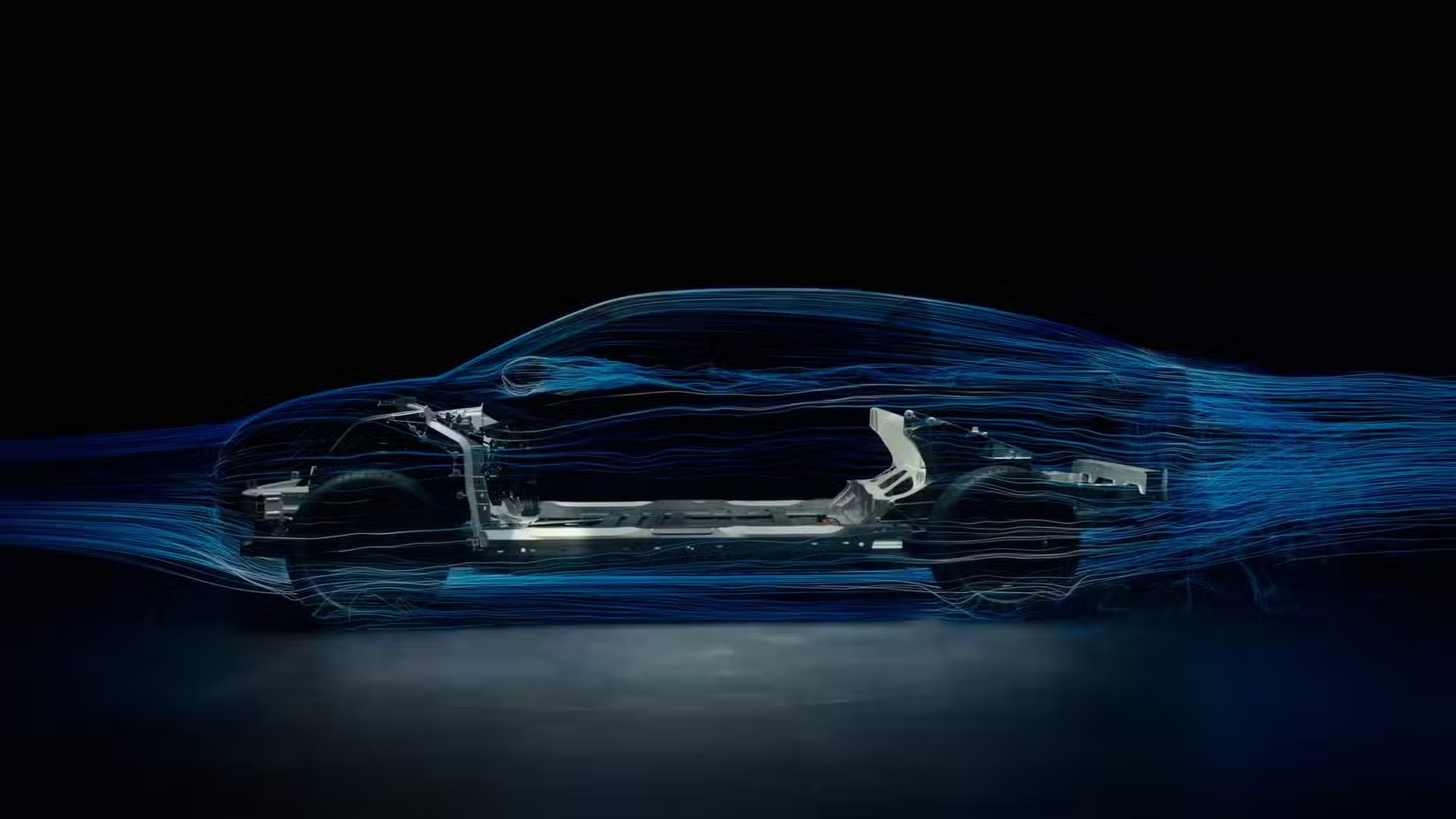
- Structural battery integration: The battery pack is no longer just a fuel source; it is a load-bearing floor component that provides structural rigidity. This “cell-to-chassis” approach removes the need for a separate heavy frame, further reducing part counts by 20% and fasteners by 25%.
While Ford is optimizing the assembly of the vehicle, the industry is also looking at the longevity of the powertrain itself. For a deep dive into the mechanical side of this endurance, read our analysis on Immortal Car Engine Technology, which explores how modern engineering aims to make hardware last a lifetime.
Timeline and efficiency targets
This shift is not a distant dream; the transition is already underway with multi-billion-dollar investments across US plants.
| Metric | Target / Impact |
| First Launch | Midsize Electric Pickup (Project T3) – 2027 |
| Assembly Speed | 15% net improvement in total throughput |
| Cost Efficiency | Targeting a $30,000 starting price for next-gen EVs |
| Workflow Density | 40% fewer workstations required dock-to-dock |

BMW iFactory: The pinnacle of digital twin flexibility
While Ford seeks efficiency through simplification, BMW’s “iFactory” represents a leap into high-tech versatility. The iFactory model is built on three pillars: Lean, Green, and Digital. Unlike traditional setups, BMW utilizes “Digital Twins”, perfect virtual replicas of their factories, to simulate production runs before a single machine moves on the floor. This allows BMW to build internal combustion engines (ICE), hybrids, and EVs on the same assembly line simultaneously.
The technical brilliance of the iFactory lies in its data integration. Every tool and robot is connected to a central cloud, enabling real-time adjustments in response to supply chain fluctuations or custom order changes. Where Ford might limit options to increase speed, BMW uses advanced robotics and AI to manage extreme complexity without losing efficiency. It is a “mastery of variety” approach that caters to the premium market’s demand for personalization.
The exit takeaway for the iFactory is clear: flexibility is the ultimate currency. By digitizing the entire production lifecycle, BMW ensures that its physical assets remain current, regardless of which powertrain dominates the next decade.

The Aria concept: Why modular repairability is the ultimate disruptor
Aria represents a radical departure from both Ford and BMW by focusing on the “after-market” lifecycle of the vehicle. The Aria modular EV concept treats the car more like a desktop computer than a traditional unibody vehicle. Its components are designed to be easily swapped, upgraded, or repaired, directly addressing the “total loss” problem many modern EVs face after minor battery or structural damage.
From a manufacturing standpoint, Aria’s approach requires a “Lego-block” philosophy. The chassis and body panels are designed for accessibility rather than permanent bonding. This modularity doesn’t just help the consumer; it simplifies the initial assembly, allowing for smaller “micro-factories” rather than the multi-billion-dollar gigaplants required by Ford. It prioritizes longevity and sustainability over the traditional high-volume turnover model.
Aria’s influence is a wake-up call to the industry. As Ford and BMW optimize for the moment the car leaves the factory, Aria asks what happens five or ten years down the line. It challenges the industry to move away from “disposable” technology in favor of enduring, modular hardware.

Comparative analysis: Scalability vs. customization vs. longevity
To better understand how these strategies stack up, we can look at their primary objectives across three critical dimensions of modern manufacturing.
| Feature | Ford Universal | BMW iFactory | Aria Modular |
| Primary Goal | Cost Reduction / Speed | Manufacturing Flexibility | Repairability / Longevity |
| Tech Focus | Hardware Consolidation | Digital Twins & AI | Modular Architecture |
| Complexity | Low (Simplified) | High (Managed) | Medium (Segmented) |
| Key Advantage | Mass Market Pricing | Extreme Customization | Reduced Depreciation |
The divergence in these three models proves that there is no longer a “one-size-fits-all” blueprint for the automotive future. While Ford’s Universal approach targets the democratization of EVs through aggressive cost-cutting, and BMW and Aria prioritize high-tech versatility and lifelong sustainability, respectively, they all share a common DNA: the departure from rigid, analog assembly. This transition from hardware-centric to software-first production sets the stage for the most significant shift of all, the rise of the factory as a living, digital organism.
The software-defined factory: The common thread
Despite their different physical approaches, Ford, BMW, and Aria are all converging on one truth: the factory is now a software product. Ford’s Universal parts are managed by sophisticated logistics software; BMW’s iFactory is a living data organism; and Aria’s modularity relies on standardized software interfaces between components. The “tech” in “Auto-Tech” is no longer just in the dashboard; it is in the arms of the robots and the code of the supply chain.
This transition marks the end of the “hardware-first” era. Manufacturers are realizing that to compete with tech-native companies like Tesla or BYD, they must treat their production lines as iterative platforms. Updates to a vehicle’s design can now be pushed to the factory floor in weeks rather than years, thanks to the digital foundations laid by these new production philosophies.
As these systems mature, the gap between “building a car” and “building a computer” will continue to shrink, leading to higher quality standards and more responsive manufacturing cycles.
The factory behind the machine
Building a $30,000 electric truck requires more than just cheaper batteries; it requires a complete reinvention of the assembly line itself. While this vehicle represents the future of the Ford lineup, the Micro-factories vs. Gigafactories debate explores whether this mass-scale “Universal” approach can compete with the rising demand for modularity and the “Right to Repair.”
Why this matters for the future of car ownership
For the average consumer, these industrial shifts translate to real-world benefits. Ford’s Universal strategy promises to keep vehicle prices competitive in an inflationary environment. BMW’s iFactory ensures that luxury buyers don’t have to sacrifice choice for the sake of sustainability. Meanwhile, the principles seen in Aria’s modularity could eventually lead to lower insurance premiums and longer-lasting vehicles.
We are witnessing a structural rebirth of the automotive industry. Whether it is through Ford’s lean “Universal” approach, BMW’s digital mastery, or Aria’s modular innovation, the goal remains the same: creating a more resilient, efficient, and technologically advanced way to move people.
Frequently Asked Questions
It is a manufacturing philosophy focused on reducing parts complexity and using standardized hardware across multiple vehicle models to lower costs and increase assembly speed.
BMW uses “Digital Twins” and AI to create a highly flexible line capable of producing gas, hybrid, and electric vehicles on the same line at the same time.
EVs are often expensive to repair due to integrated battery packs. Modular designs allow for specific components to be replaced, extending the vehicle’s life and reducing insurance costs.
While Ford’s strategy takes cues from the “Toyota Production System” (Lean manufacturing), it adds modern software integration and EV-specific hardware consolidation that goes beyond traditional lean methods.
Ford’s strategy specifically targets cost reduction to make EVs more affordable, while BMW’s focus is on maintaining premium variety without increasing prices exponentially.